

Microsoft Fabric Data Engineering Bootcamp — Pune & Online
India’s most comprehensive Microsoft Fabric data engineering course. From Module 1, you build an end-to-end enterprise pipeline on Fabric — OneLake, PySpark, Eventstreams, and Purview — and every module adds a new, production-grade layer. DP-700 certification prep included. Classroom in Pune or live online across India.
Not sure if this is right for you? Take the free AI Maturity Assessment →
Microsoft Fabric Data Engineering Bootcamp — Key Facts
Hands-On Instruction
Production Labs
Modules + Capstone
Continuous Pipeline
Certification Prep
Exam-Mapped Labs
Classroom, Pune
Instructor-Led
“Microsoft Fabric is one of the most important data platform shifts since the introduction of cloud data warehouses. Engineers who understand its unified architecture will define the next decade of enterprise data.”
— Senior Data Architect, Microsoft Partner Network
MCAL vs Generic
MCAL Fabric Bootcamp vs Generic Online Courses
Here’s what sets MCAL apart from every other Fabric course in India.
| Feature | MCAL Bootcamp | Generic Course |
|---|---|---|
| Hands-on Lakehouse | Full enterprise architecture lab | Conceptual only |
| Real-Time Pipeline | Live ingestion with Eventhouse | Rarely covered |
| DP-700 Prep | Dedicated module + mocks | Self-study only |
| Medallion Architecture | Bronze → Silver → Gold | Mentioned, not practiced |
| Enterprise Security | RLS, CLS, Purview | Skipped |
| Instructor Access | Live Q&A, guided labs | Pre-recorded |
| Capstone Project | Full enterprise pipeline | Toy datasets |
8-Module Curriculum
Production-Grade, Session by Session
Lab: Provision a Fabric workspace, create a Lakehouse, configure OneLake folder structure and shortcuts
Pipeline Progress: Your Fabric workspace and OneLake infrastructure is live and configured
Lab: Build a multi-source ingestion pipeline pulling from REST APIs, ADLS Gen2, and SQL into OneLake
Pipeline Progress: Multi-source data is flowing into your OneLake landing zone
Lab: Design and deploy a three-layer Medallion Lakehouse with Delta tables and V-Order optimization
Pipeline Progress: Your Medallion Lakehouse is structured with governed Bronze, Silver, and Gold layers
Lab: Write a parameterized PySpark notebook that incrementally loads, transforms, and merges into Gold
Pipeline Progress: Your data is clean, optimized, and production-ready with automated transformations
Lab: Build an orchestration pipeline with conditional logic, parameterized notebook calls, and scheduled runs
Pipeline Progress: Your pipeline runs automatically with scheduled orchestration and error recovery
Lab: Implement RLS on a semantic model, configure Purview lineage, and run a compliance audit
Pipeline Progress: Your pipeline is enterprise-hardened with multi-layer security and governance
Lab: Tune a Spark job using DAG analysis, run OPTIMIZE/VACUUM, and benchmark CU consumption
Pipeline Progress: Your pipeline is cost-efficient and performance-benchmarked for production workloads
Lab: Present your capstone architecture, complete mock exam scenarios, and map labs to DP-700 domains
Pipeline Progress: Complete — you are interview-ready and certification-ready
After This Bootcamp
Job-Ready Engineering Outcomes
Design and deploy a production-grade Medallion Lakehouse on Microsoft Fabric using Delta Parquet with V-Order optimization
Build multi-source ingestion pipelines using Fabric Data Factory, Dataflows Gen2, Eventstreams, and REST API connectors
Write production-quality PySpark and Spark SQL notebooks with error handling, logging, and incremental load patterns
Architect real-time data ingestion using Eventstreams and Eventhouse (KQL Database) for streaming analytics
Implement enterprise orchestration using Fabric Pipelines with dynamic parameters, conditional logic, and retry policies
Apply RLS, CLS, and Microsoft Purview for governed, audit-ready data solutions with full lineage tracking
Perform Spark DAG analysis, CU monitoring, and Delta maintenance (OPTIMIZE, VACUUM, Z-ORDER) for performance tuning
Confidently sit for — and pass — the DP-700: Microsoft Certified Fabric Data Engineer Associate exam
Tools & Technologies
What You Will Master
Who Is This For
Built for Engineers Ready to Architect & Build
Azure Data Engineers
Working on Synapse, ADF, or Databricks — add Microsoft Fabric to your production toolkit and stay ahead of the platform shift.
SQL Server / SSIS Devs
Transitioning to cloud-native, lakehouse-first data engineering. Take your SQL skills into the modern Fabric ecosystem.
Data Architects & Leads
Evaluating Microsoft Fabric for enterprise implementation. Get the hands-on validation you need for informed architecture decisions.
Analytics Engineers
Managing dbt or Power BI — understand the full Fabric data stack underneath and own the entire pipeline, not just the analytics layer.
Why MCAL
What Makes This Microsoft Fabric Bootcamp Different
One Continuous Pipeline. Every module adds a real, working layer. By Module 8, you have a complete, production-grade Medallion Lakehouse — not isolated exercises.
Enterprise Gotchas Included. Each module includes real practitioner-level warnings about mistakes that cost enterprises time and money.
DP-700 Certification Track. Dedicated capstone module with exam blueprint walkthrough, mock scenarios, and lab-to-exam mapping.
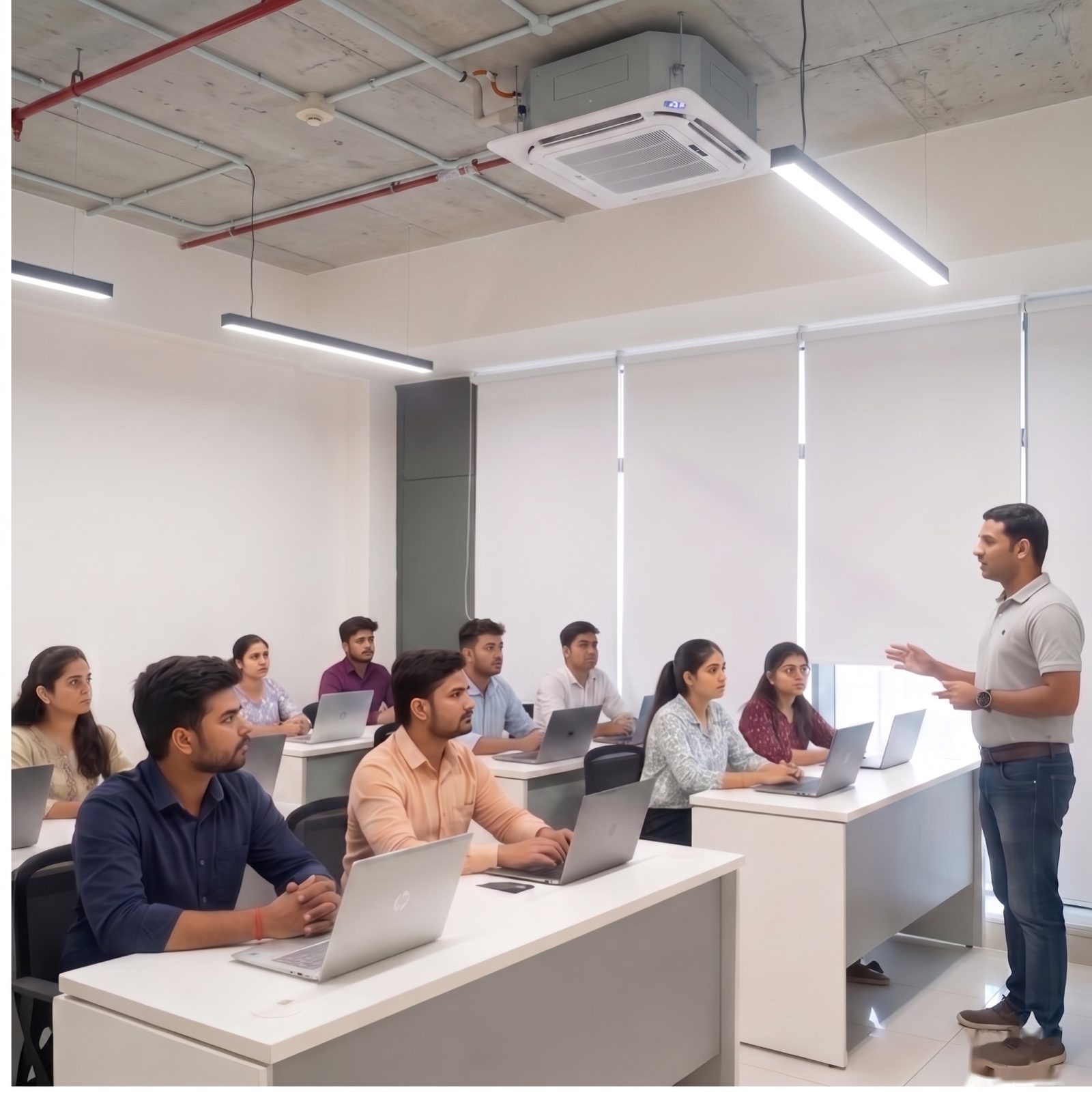
Live Classroom, Pune. Instructor-led, hands-on, with real-time Q&A and guided labs. No pre-recorded videos. No self-paced isolation.
Enterprise-Grade Depth. V-Order, Liquid Clustering, DirectLake, CU monitoring, RLS/CLS, Purview — topics that separate production engineers from tutorial watchers.
Authority & Trust
Proof, Not Promises
15,000+ professionals from India's top enterprises have trained with MCAL Global since 2010.
IIBA Endorsed
16+ Years
Global Footprint
Enterprise Trusted







Market Context
The Demand Is Real. The Talent Gap Is Massive.
Avg US Salary
India Mid-Level
Engineers w/ Fabric
To Close the Gap
Frequently Asked
Questions & Answers
Your Next Step
Build a Production-Grade Pipeline
in 30 Hours
Microsoft Fabric is the present. Engineers building on it now will define enterprise data for the next decade.
30 hours · 8 modules · DP-700 prep · Enterprise capstone · Certification