

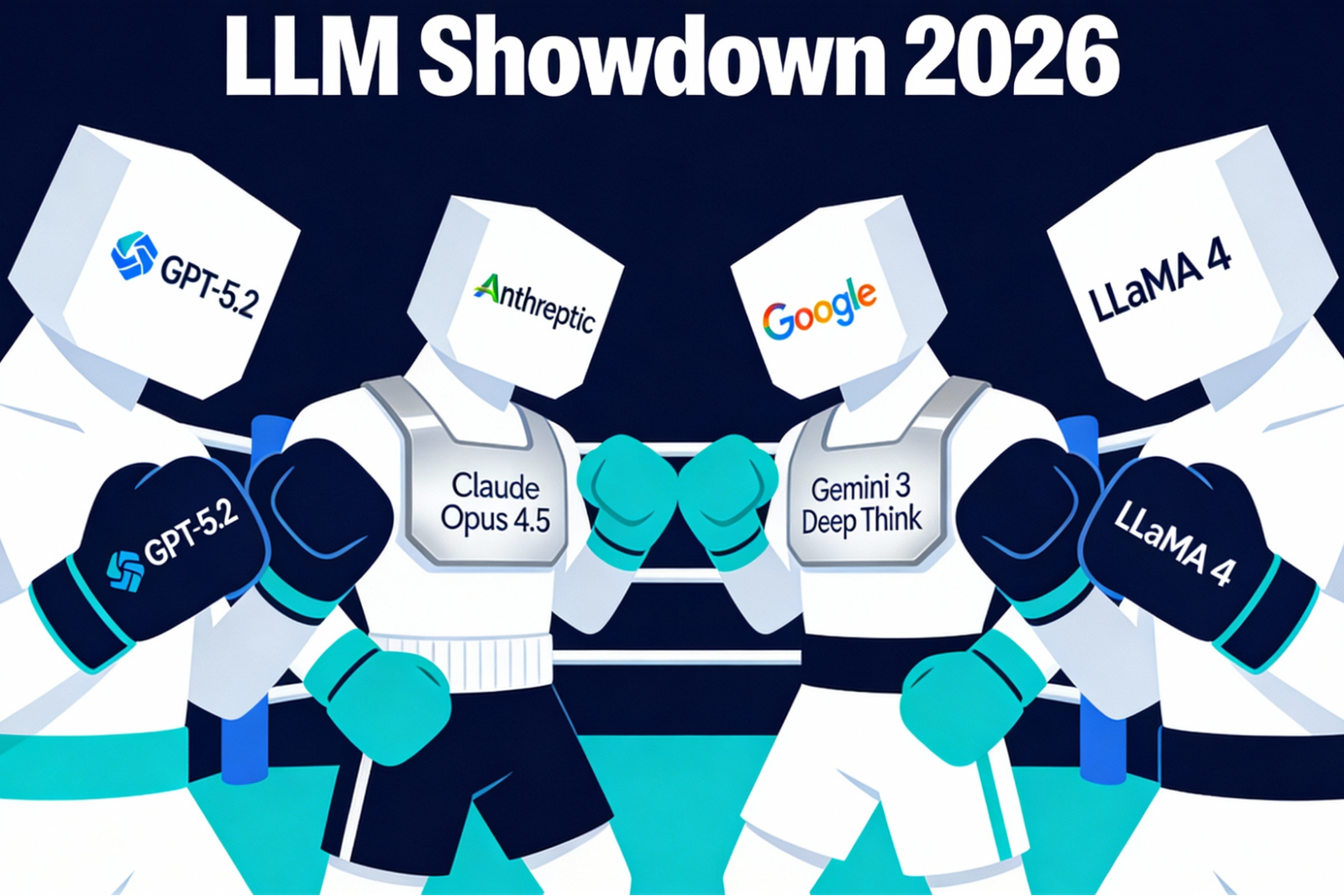
In 2024, chatbots gained attention for their ability to draft emails, write essays, and simplify documentation. By 2025, the focus had shifted toward their reasoning capabilities.Now in 2026 LLMs are moving forward from novelty to essential enterprise tools, becoming experts for tasks like coding, finance and marketing,evolving into autonomous agents focusing heavily on multimodal understanding, and facing critical challenges around cost, accuracy (hallucinations), data privacy, and ethical governance, with open-source models closing the gap with proprietary ones.
We have entered the AI-Augmented Era . Models that don’t just predict the next word, but deliberate, plan, and execute without human intervention. This is the LLM Showdown: It’s a clash between automated work, fresh ideas, and the practical limits of mental effort. GPT?5.2(Generative Pre-trained Transformer), Claude Opus 4.5, Gemini 3 Deep Think, and Llama 4 (Large Language Model Meta AI) form four of the most significant models leading this new frontier, and each one was built with different personalities ,strengths and weaknesses.
Table of Contents
ToggleModel Snapshots: Explaining the 2026 Landscape in Simple Terms
1. GPT-5.2
The analytical architect of OpenAI’s latest flagship isn’t just one model; it’s a family of “Thinking” tiers. GPT-5.2 is built on a Search-Augmented Reasoning architecture.
- What’s New: It features Test-Time Compute (the ability to pause and think for minutes before answering).
- The Edge: It has almost entirely solved the hallucination problem in logic. If you give it a complex legal contract, it doesn’t just summarize; it finds the one conflicting clause hidden on page 400.
- The Flaw: It is notoriously stiff. It lacks the creative flow of its predecessors, often sounding like a hyper-cautious actuary.
2. Claude 4.5 Opus
The Coding Powerhouse of Anthropic has doubled down on Computer Use and Long-Horizon Agency.
- What’s New: Claude 4.5 doesn’t just write code; it operates the computer. It can view your screen, move the cursor, and navigate terminal environments to fix bugs autonomously.
- The Edge: It leads the pack in Steerability. It follows complex, multi-layered instructions better than any other model.
- The Flaw: It remains the Hall Monitor. Its safety guardrails can still be overly sensitive, occasionally refusing benign requests if they sound remotely like a copyright or policy edge-case.
3. Gemini 3 DeepThink The Multimodal Giant of Google has finally unified its ecosystem. Gemini 3 is the first model to be Natively Multimodal from the ground up; it doesn’t just translate images to text; it sees them.
- What’s New: A 2-million-token context window that is now active memory, meaning it can recall details from a 10-hour video file with 99% accuracy.
- The Edge: Integration. It is the only model that can pull real-time data from Google Search, Maps, and Workspace simultaneously to solve a problem.
- The Flaw: Context Fatigue.While it can read 2 million tokens, it sometimes loses the thread of the original prompt in favor of the massive amounts of new data it just ingested.
4. Llama 4 Scout & Behemoth The Open-Source Fortress of Meta’s Llama 4 has shattered the “Open Source is 6 months behind” myth.
- What’s New: The “Scout” model (a lightweight 70B) is designed for edge devices, while “Behemoth” (400B+) is a direct competitor to GPT-5.2.
- The Edge: Privacy. For companies that cannot send data to the cloud, Llama 4 is the gold standard for on-premise, high-intelligence deployments.
- The Flaw: Hardware Hunger. Running Llama 4 Behemoth at full speed requires a massive investment in local H100 clusters, making the “free” model very expensive in terms of electricity and silicon.
The War of the Benchmarks
Why do we still use benchmarks? Because in 2026, the difference between a 70% and an 80% score isn’t academic; it represents thousands of dollars in saved human labor.
Event 1: SWE-bench Verified It is the Engineering Test this benchmark requires the AI to solve real-world GitHub issues.
- The Champion: Claude 4.5 Opus (80.9%).
- Why it Matters: High-school level “LeetCode” is easy. SWE-bench tests if the AI can handle a 2026-sized repository with dependencies, conflicting libraries, and messy documentation.
- Business Impact: Using Claude 4.5 can reduce “Green Build” time by 40% in enterprise environments.
Event 2: ARC-AGI-2 This Intelligence Test is Designed by François Chollet, this test uses novel logic puzzles the AI hasn’t seen in its training data.
- The Champion: GPT-5.2 Pro (54.2%).
- Why it Matters: This is the “Zero-Shot Innovation” test. Most LLMs are just “calculators for words.” ARC-AGI-2 proves GPT-5.2 can actually think through a new problem it wasn’t trained on.
- Business Impact: Essential for R&D departments working on proprietary physics or chemistry problems that don’t exist on the open internet.
Event 3: Humanity’s Last Exam This is the Expert Test a PhD-level test across multiple scientific disciplines.
- The Champion: Gemini 3 DeepThink (41.0%).
- Why it Matters: This tests “Cross-Domain Synthesis” the ability to understand how a breakthrough in material science might affect aerospace engineering.
- Business Impact: The ultimate tool for strategic consulting and high-level academic research.
The Pragmatic Economy
In 2026, performance is no longer just about accuracy. It’s a three-way trade-off between Accuracy, Latency (Speed), and Token Cost.
1. The Reasoning Token Economy GPT-5.2 and Gemini 3 now use Test-Time Compute. This means when you ask a hard question, the model thinks internally. The Cost: You are billed for those internal thinking tokens. The Verdict: A Deep Think query can be 10x more expensive than a standard response. Businesses must now decide: Is this question worth a $5 thinking fee?
2. Speed vs. Agency Gemini 3 Flash is the speed king, delivering 300 tokens per second. It’s perfect for real-time customer support. Claude 4.5 is slower but more autonomous. It might take 30 seconds to start, but it finishes the task in one go, whereas a faster model might require five follow-up prompts to get it right.
3. The Accuracy Gap The “hallucination rate” for frontier models has dropped significantly:
- GPT-5.2: <1.5% in technical documentation.
- Claude 4.5: <1.8% in coding tasks.
- Llama 4: ~3% (requires RAG to be reliable).
LLM Showdown: The 2026 Comparison
| Feature | GPT-5.2 Pro | Claude 4.5 Opus | Gemini 3 DeepThink | Llama 4 Behemoth |
| Primary Strength | Raw Logic / R&D | Autonomous Coding | Multimodal Context | Privacy / On-Prem |
| Agentic Autonomy | Medium (Tool-use) | Extreme (Computer Use) | High (Google Ecosystem) | High (Customizable) |
| Thinking Mode | “Thinking” (Slow/Paid) | “Effort Control” | “Deep Think” | NA (Hardware limited) |
| Context Window | 400K | 200K (1M Preview) | 2M (Active) | 128K – 1M |
| Cost (per 1M) | $15.00 (avg) | $15.00 (fixed) | $20.00 (Ultra) | $0 (Self-hosted) |
| Best For | Strategic Planning | Engineering Teams | Research & Media | Defense & Banking |
The era of the “one-size-fits-all” AI is over. In 2026, success demands Strategic Orchestration knowing exactly when to deploy Claude for autonomy, Gemini for speed, or GPT-5.2 for deep strategy. The human role has shifted from prompter to manager, and the future belongs to those who can effectively conduct this symphony of specialized intelligence.
Sources & References
LLaMA 4 – MetaAI
GPT 5.2 – OpenAI
Claude Opus 4.5– Anthropic
Gemini 3 Deepthink – Google